Camp Beret Begins

Taken from The Navigators site.
Image found on navigators.org.

posted by Beret

Well, it happened.

It happens every year.

The end of the school year approached, mayhem ensued, and now the two best reasons to ignore everything else in the world are in my house 24/7.

It’s looking a little grim for a post until “Camp Beret” goes on a brief hiatus July 8.

Who knows, my esteemed co-conspirator Gina might make a surprise appearance, or I might get lucky and squeeze out a book review before mid-July. But just in case, I’m sending apologies in advance.

Since many of you are experiencing a spike in quality time with your kids as well, might I suggest perusing the archives? Perhaps this is the summer to mummify a chicken, or make a lemon battery, invisible ink, or ice cream in a bag. Maybe you want to try extracting DNA from fruit, or use cabbage juice as a pH indicator. Now’s your chance.     Continue reading “Camp Beret Begins”

Ice Cream in a Bag!

©2013 Beret Olsen
©2013 Beret Olsen

posted by Beret

Ages: Any, though the very young will get tired of shaking long before the ice cream is ready.

My kids never took to Sesame Street, or Mickey Mouse, or the Disney Channel; they didn’t care for children’s movies, either. For the most part, I appreciated that, and enjoyed my Dora-free existence. It did become an issue, however, when I desperately needed to make a phone call, or do my homework, or even just have five minutes of unchaperoned time in the bathroom.

As the girls got older, they got better at amusing themselves from time to time, but sick days remained problematic. I would eventually run out of patience with Barbies (for the moderately ill) and with ladling tea and stroking hair (for the flu victims). Unfortunately, my youngest was frequently fighting some bug or another. I heard myself asking: please, please, wouldn’t you like to watch twenty minutes of television? Sadly, no.

But one day last January, my seven-year-old got a glimpse of the Food Network. Now I have that “be careful what you wish for,” kind of feeling. “That’s not how you do a chiffonade,” Josie told me later, as I chopped mint for the top of a fruit salad. “I think there has been a misunderstanding,” she said another time, catching me frosting her fancy ganache-filled mocha birthday cupcakes with a tub of Betty Crocker vanilla.

What can I possibly make for dinner now, when both girls are glued to Iron Chef Morimoto‘s every move?    Continue reading “Ice Cream in a Bag!”

The Quick and Dirty Guide to Paper Marbling

opening2
©2013 Beret Olsen

Ages: 4 and up

I’ve done paper marbling many times, occasionally with satisfying results. Unfortunately, it required a checklist of fussy materials, as well as a sizable chunk of time. Something called ‘size’ had to be mixed ahead of time and allowed to thicken, but not so far ahead of time that it got moldy. Paper had to be pre-treated with mordant and allowed to dry. Who has time for all of that?

I also noticed that I was getting a little precious about the supplies–i.e., I had a hard time sharing them with my kids. That’s because up until a week or so ago, I thought the only way to marbleize was to buy the kit off Amazon, or drive around town trying to find ingredients like alum and methyl cellulose.

Full disclosure here: those are the materials and methods you need to use if you want those amazingly delicate Martha Stewart-y results. If you want to create papers that precisely resemble the endpapers found in old leather-bound books, and if time is not an issue, then by all means go and do it that way.

BUT.

Marbling is fun. And cool. Why not try it with cheaper, more easily accessible supplies? That way, you might be more likely to do it with a group of kids, or with your own, on some random rainy day when you are desperate to squelch the endless bickering. Not that my kids ever behave that way.

So, here it is: the cheap and easy method for marbleizing paper.    Continue reading “The Quick and Dirty Guide to Paper Marbling”

How to glue stuff like a crafty mofo

posted by Beret

IT’S SPECIAL ADDED BONUS TIME!

For those of you who would like to amaze your friends and family members with some mad gluing skills, this post is for you. Not interested? You still may want to take a peek down at step #5, which has a link to make a book press out of two cutting boards.

The techniques outlined below could apply to a myriad of different projects involving paper. In the demo, I am gluing the accordion book from a previous post into its attractive cover. If you’re looking for something else to make, try ‘crafty mofo.’ There you will find a boatload of interesting things to make–plus a few ugly ones, to be sure.     Continue reading “How to glue stuff like a crafty mofo”

Ridiculously Simple Bookmaking Part Deux: The Accordion Book

@2013 Beret Olsen
@2013 Beret Olsen

posted by Beret

Age Range:  anyone who can fold a piece of paper

You may be wondering: where is Gina?? Well, Gina is taking a moment to figure out some big life questions. I have tried to explain that the answer is 42, but for some reason, she insists on figuring things out for herself.

So I am back with another ridiculously simple bookmaking idea. The pages of an accordion book are made from one very long piece of paper, folded like an accordion. Hence the name.    Continue reading “Ridiculously Simple Bookmaking Part Deux: The Accordion Book”

Ridiculously Simple Bookmaking Part One: The Stick Journal

@2013 Beret Olsen
@2013 Beret Olsen

posted by: Beret

Ages: Three and up, though the very young will (of course) need assistance.

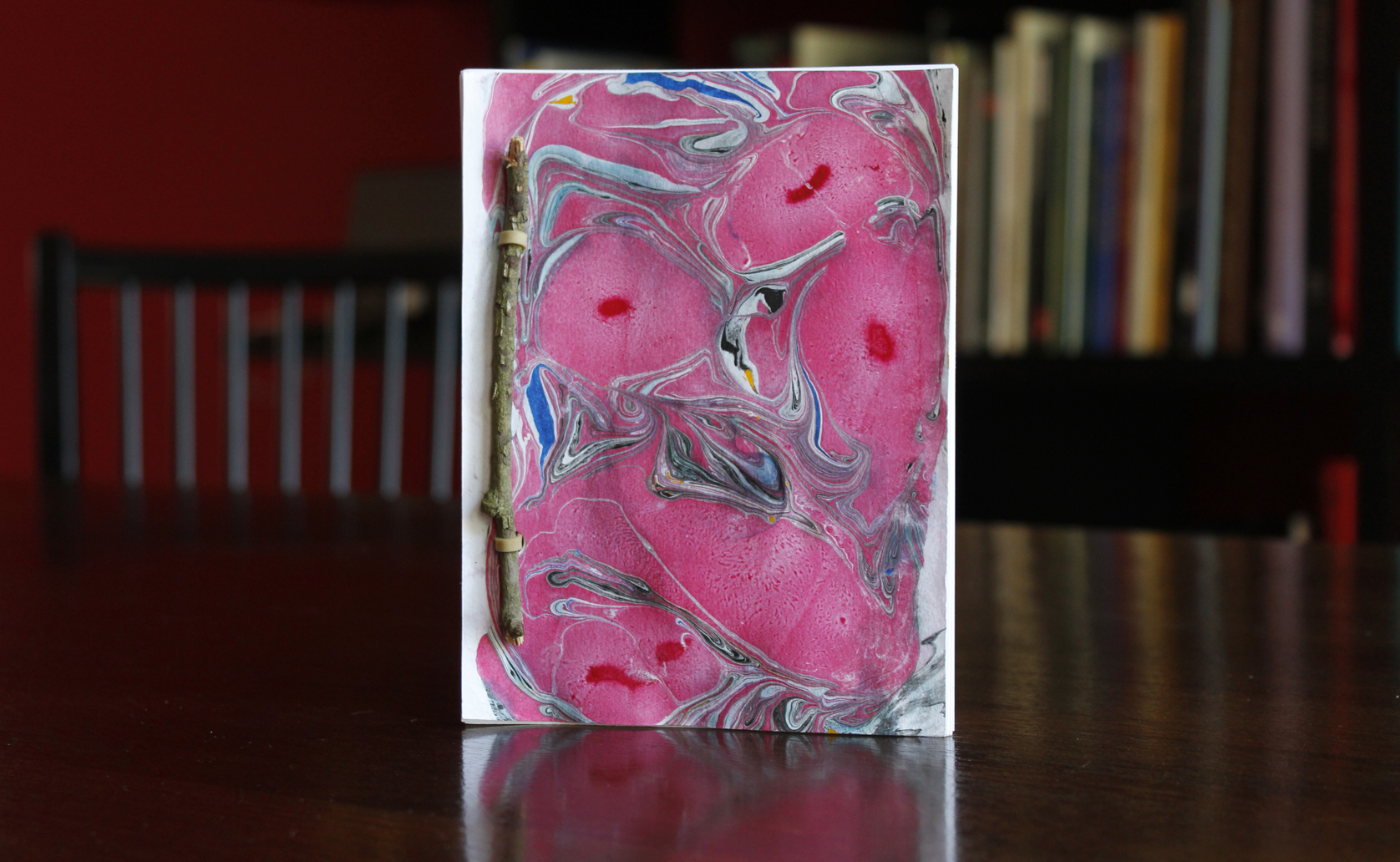
I love to make books.

I was going to do a very thorough post including all kinds of different bookmaking ideas. But then I realized the enormity of the challenge. There are a million ideas out there, and I am not to be trusted endlessly surfing the web. Somehow or another, I always end up on Youtube watching a couple of nimrods having a staple gun fight. In light of this, I decided to narrow my focus and introduce one project at a time.    Continue reading “Ridiculously Simple Bookmaking Part One: The Stick Journal”

The Trilogy Grail Achieved

(A.K.A. Life After the Hunger Games: Part Three)

posted by Gina

Well, my friends, it’s been found: a post-apocalyptic dystopian teen romance trilogy with a wholly satisfying third installment.  I’ll tell you the truth, I hardly dared to hope – but it has been found.

This is a terrible cover. Please do not judge this book by it.

Welcome to the world of the Matched trilogy, by Ally Condie.  The first book, Matched, is an intriguing mash-up of Lois Lowry’s The Giver and the reality TV show The Bachelor.  The premise: our heroine, Cassia, is attending her Matching Ceremony Banquet – the single most important ceremony within the Society.  All young people in the Society attend such a banquet during their 17th year.  Girls are able to choose one of several Society owned gowns, dessert (a known but rarely experienced luxury) is served, and Matches (citizens’ researched and carefully chosen future mates) are revealed. Matches are optimally paired for success, contentment, and longevity, and Cassia has been eagerly looking forward to this night.  Her match is unusual, but not disappointing: a boy she already knows, from her own city, one of her close friends.   Continue reading “The Trilogy Grail Achieved”

Learning to Love Math

posted by Beret

I love math.

It’s possible I love it because I had a very handsome math teacher.

More likely, it’s because I had a very handsome, very effective math teacher at an impressionable age. Junior High was such a wasteland of raging hormones, brutal social cliques, and boring grammatical exercises;  Mr. W. was like a shining star in the midst of it all. Unfortunately for him, we loved him eighth-grade style; we were constantly doing ridiculous things to get his attention. One day we spoke without making a sound–just mouthed words–for the entire class period. Once we stacked the desks in a pile and sat on the floor in a circle, like kindergartners. But Mr. W. was well acquainted with thirteen-year-olds, and remained completely unfazed. Not only did he maintain his sense of humor, he doggedly plowed through the equations, vividly illustrating the meaning of X with his wacky stories and chalk drawings of widget factories. Thanks to Mr. W., algebra still makes happy sense to me and everyone else who drove him crazy.

Someone killed math for a lot of people, which is a crying shame. If your child hates math, though, it might not be their teacher’s fault. It might not even be because of you and your own math badditude. It might just be the way our culture seems to throw up their hands in the face of it. People make jokes about their inability to do math in a way that they would never, ever do about reading. They dismiss the ability to calculate by pointing to the computer and asking, “why bother?”    Continue reading “Learning to Love Math”

Milk Carton Wallets

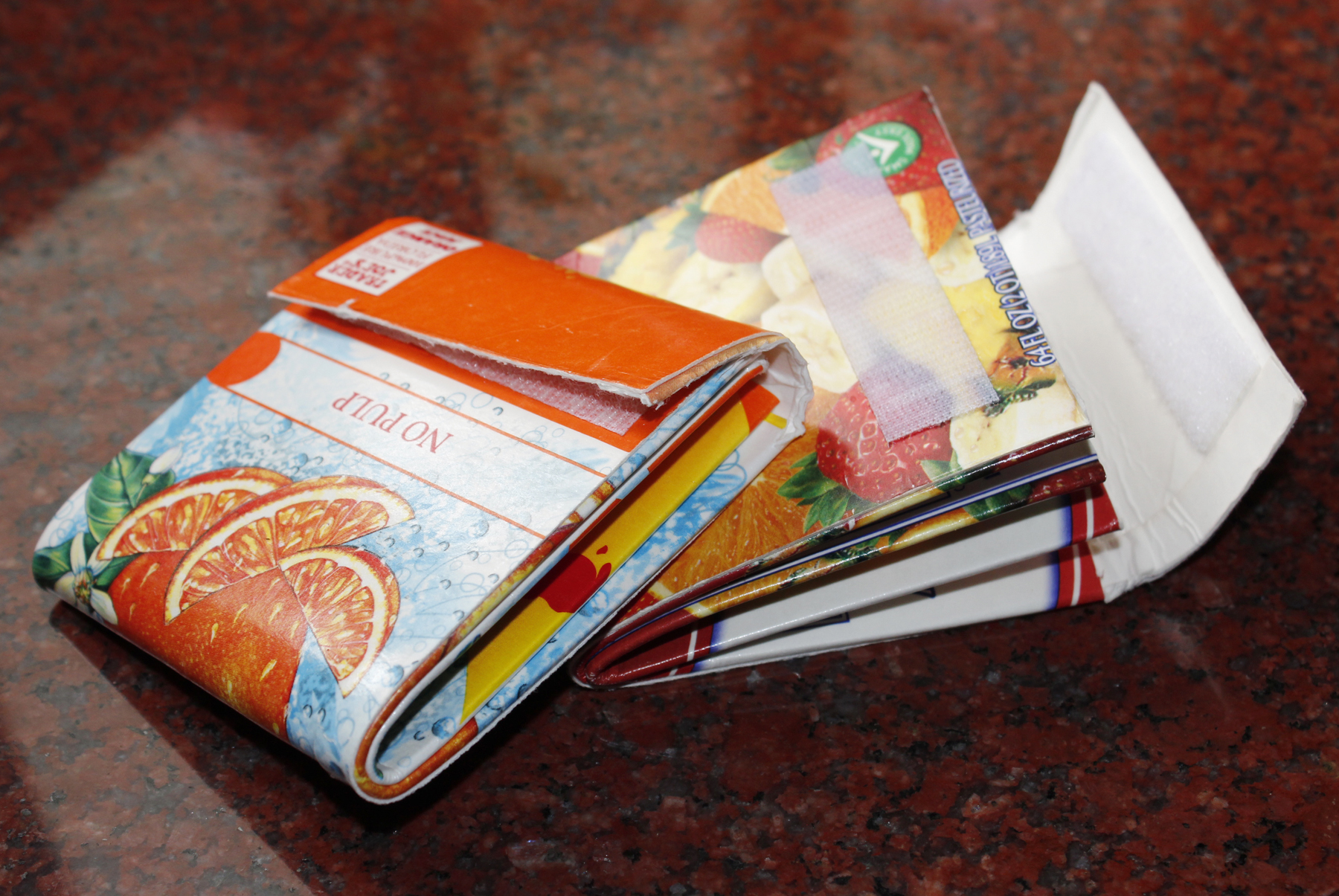
Perhaps I should call these juice carton wallets.  ©2013 Beret Olsen
Perhaps I should call these particular iterations juice carton wallets.                                           ©2013 Beret Olsen

posted by Beret

Ages: 6 and up

The first time I saw a milk carton wallet, it was in a giant pile laying on a table. Some lovely design student had made them about 150 of them, and was handing them out at portfolio night. She probably had her card tucked inside; I really don’t know. I don’t even remember a thing about her portfolio. Perhaps it was creative and fabulous. I was just mesmerized by that pile of wallets at her table. I took one, went home, and drank a lot of juice.

The rest is history.

“What?” you say. You already have a duct tape wallet? Well, that’s awesome. But someday, it’s going to be so rainy, or snowy, or just plain boring, that you will need something new and amusing to do. And this project is so simple and cheap, you may be surprised you haven’t tried it already.    Continue reading “Milk Carton Wallets”

Life After the Hunger Games: Part Two

(A.K.A. Excellent Post-Apocalyptic Trilogies with Disappointing Third Installments)

Posted by Gina

After finishing the Hunger Games Trilogy, most of us went through the Five Stages of Mockingjay Grief:  sadness (over the various tragedies within the plot), disorientation (“Wait, WHAT?”), confusion (“Surely there are 40 pages missing from my copy.”), anger (“Seriously?”), and, finally, long-term vague disappointment.

It’s frustrating when a trilogy builds, for hundreds of pages and months of waiting between editions, to the inevitable Final Ultimate Choice, and then peters sadly out, with some form of Deus Ex Machina of circumstance and inconsistent character choice leading to the negation of said final choice.  There’s no final stand.  There’s no ultimate decision.  There’s merely a vague settling of elements and the feeling that we, the readers, have been cheated out of something.

Sadly, a lot of wonderful (specifically young adult dystopian romance) trilogies seem to have underwhelming third books, leading us to suspect that publishers are rushing publication or insisting on drawing a two-book idea out when it shouldn’t be.  Going in forewarned is half the battle; we can enjoy our first two books to the fullest and go into the third taking what we can and shrugging our shoulders over the rest.

The following trilogies are my go-to series recommendations for anyone who enjoyed the Hunger Games Trilogy.  They’re good for a wide-range of ages (both are considerably less violent and the romance is of the 6th Grade variety) and have the same kind of across-the-board appeal.

The MazeRunner Trilogy, by James Dashner

(Googling for the cover image, I see that this is about to made into a film.  So please go read it now before it’s messed around with.)

Our protagonist, Thomas, wakes up in an elevator with no memory, and finds himself delivered into a mysterious glade inhabited by other boys, surrounded by an ever-changing moving stone maze.  Where did they come from?  Why are they there?  Who’s watching them?

This is one of those fun, science-fiction-y, social experiment books where we put the pieces together along with Thomas.  It’s an absorbing read, and the sequel, The Scorch Trials, is close to as good.  The third installment, The Death Cure, is one of those books we finish because we want to know how it all ends, but is infinitely disappointing in its feel and conclusion.  It’s not bad, but it lacks the energy and drive of the first two.  And, like Katniss in Mockingjay, Thomas is ultimately robbed of his opportunity to make a final stand and clear cut choice.

The Uglies Series, by Scott Westerfeld

This series held me entirely enthralled for two books (Uglies and Pretties), but about halfway into the third (Specials), I found myself increasingly tired of this particular world.  Interestingly, the bonus fourth book (Extras) renewed my interest, having mixed things up enough to re-engage me.

In this post-apocalyptic society, all citizens undergo an operation to become ‘Pretty’ at age 16.  Young pretties live only for pleasure – going to parties, wearing fabulous clothes, and eating amazing meals.  Much of the fun of reading Pretties is inhabiting PrettyTown along with the characters.

The first book focuses on Tally, an Ugly close to her 16th birthday who’s never doubted that she’s ugly and that all she needs to be happy is her operation and subsequent move to PrettyTown.  A new friend and a visit to a mysterious settlement outside her society makes her begin to question what she’s always assumed to be true.

 Pretties and Specials both continue Tally’s story, but Specials finds the series beginning to pall.  The same plot formula has been employed at the end of the first two books, and we find ourselves tired of the veiled predictability.  I’ve re-read both Uglies and Pretties several times, but haven’t returned to Specials.

 Extras, a bonus fourth installment, breathes a new life into the series.  Changes have been made to Tally’s world, and while she exists in the story, she’s not the character we focus on.  The new societal structure (is it better?  Is it really the same, just under new constraints?) is interesting, and the new protagonist is a likeable underdog, a relief after tiring of Tally’s story.

The good thing about trilogies being the current It Girl of the Young Adult Literature world is that when we find an exciting story we are likely to be getting more of it.  But I’m still waiting for that amazing post-apocalyptic series that stays strong until the final page of the final chapter – let me know if you find it before I do.

Did you miss the first Life After the Hunger Games? Find it here.